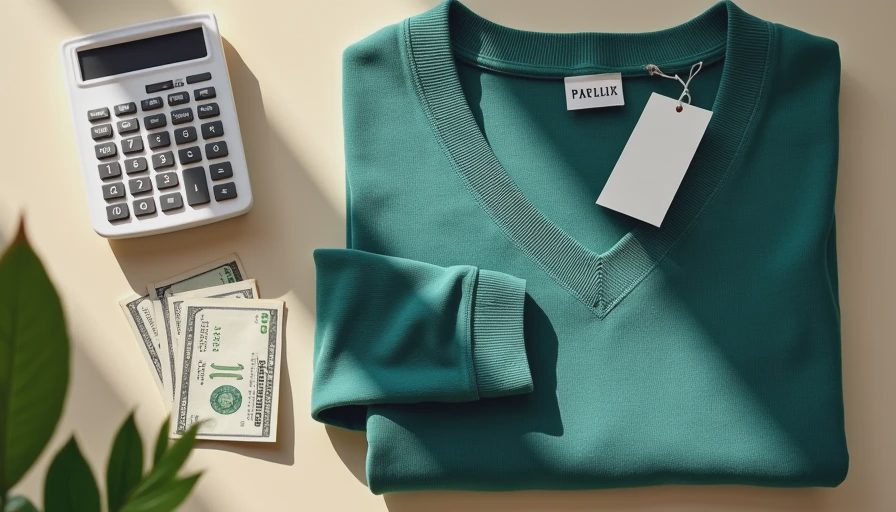
The cost per wear definition is simple: divide what you paid for a piece of clothing by the number of times you wear it. That little bit of math can change how you shop, especially if your closet contains a graveyard of low-priced tops with tags still attached. A $90 sweater worn 30 times costs $3 per wear. A $25 sweater worn once costs $25 per wear. The math is not glamorous, but it is useful.
I started using this calculation after years in fitting rooms at Von Maur in West Des Moines. Women would apologize for considering a $120 jacket, then buy three $35 jackets that never worked with their lives. The price tag felt safer. The closet did not.
The cost per wear definition in plain English
Here is the entire formula: purchase price divided by total wears equals cost per wear. If you pay $60 for jeans and wear them 20 times, the result is $3 per wear. Wear them 60 times, and the number drops to $1.
The calculation includes the original price, not the suggested retail price. If a $100 cardigan is marked down to $65, use $65. If you apply a $10 store credit and pay $55, use $55. Shipping and tailoring can be included when they are part of your actual cost. I usually leave out tax because I want a quick comparison, but adding it is perfectly reasonable if you are comparing two expensive purchases.
The important part is estimating wears honestly. Do not count the imaginary life where you suddenly become someone who attends three gallery openings a month. Count the workdays, school concerts, grocery runs, and Saturday mornings when you will actually reach for the item.

Why a cheaper item can cost more
The cost per wear definition exposes a common shopping trap: inexpensive does not always mean economical. Imagine a $28 blouse in a color you rarely wear. You buy it because the price is painless, but it hangs in the closet for six months. Its cost per wear is $28.
Now compare a $78 navy blouse with washable fabric, sleeves that stay put, and a shape that works under your gray cardigan. You wear it twice a month for a year, or 24 times. That is $3.25 per wear. After two years, the number is $1.63.
This does not mean every pricier piece deserves a place in your closet. A badly made $150 jacket is still a bad purchase. It means the sticker price is only one part of the decision. Reach, comfort, laundering, color, and whether the item works with your existing shoes all affect the final number.
How to estimate wears before buying
Before you buy, picture three specific outfits. Not vague outfits. Say them out loud: black ankle pants with the blue sweater, straight-leg jeans with the striped shirt, and a denim skirt with the cardigan. If you cannot name three combinations, the item is asking your closet to do too much work.
Next, ask where the garment fits into your week. A silk camisole might be beautiful, but if your life is school pickup, office meetings, and a damp Iowa soccer field, it may not get many wears. A machine-washable knit top could reach 40 wears in a year because it handles real errands.
Finally, consider friction. A dress that needs special undergarments, delicate steaming, and a particular heel has a higher practical cost than the receipt suggests. The cost per wear definition works best when your estimate includes the small annoyances that make you avoid clothing.
A real-life cost per wear example
A client once brought me two pairs of pants. One was a $42 fast-fashion pair bought online. The waistband rolled, the pockets pulled open, and the fabric showed every wrinkle. She had worn them twice. Her current cost per wear was $21.
The other pair was a $96 pair of ponte pants from a department store. They had a smooth waistband, enough stretch for sitting through a parent-teacher conference, and a hem that worked with her flat shoes. She wore them once during our appointment, then told me she had worn them 18 times over the next four months. That put the cost per wear at about $5.33. If she reaches 40 wears, it falls to $2.40.
Neither pair was a magical investment. The second simply matched her schedule, comfort needs, and existing wardrobe. That is the useful lesson: buy for the life you already live, not the version of yourself who might appear next season.
What costs should you include?
The cost per wear definition can be as basic or detailed as you need. For everyday shopping, use the purchase price and an honest wear estimate. For a special item, add the costs that influence whether you will use it.
A $110 blazer requiring a $25 sleeve adjustment has a real cost of $135. If you wear it 30 times, that is $4.50 per wear. A $65 sweater that requires $8 dry cleaning after every few uses might eventually cost more than expected, especially if you avoid it because laundry is a nuisance.
Also consider replacement costs. A $40 handbag with a strap that breaks after eight uses has a $5 cost per wear, before counting the frustration. A $95 bag carried 150 times costs about 63 cents per use. Materials, stitching, zippers, and lining matter because durability gives your purchase more opportunities to earn its place.
Do not turn this into an accounting project. A quick note in your phone is enough. Record the item, price, and each wear with a tally mark. After a month, your assumptions will be much more accurate.
When cost per wear should not decide everything
Math is a tool, not a boss. A winter coat may have a higher cost per wear because you only use it during cold months, but warmth and safety still matter. A dress for your niece's wedding may be worn twice and still be worth buying if renting is inconvenient and the event matters to you.
Sentimental clothing also operates by different rules. The sweater you wore home from the hospital after your daughter was born does not need to reach 50 wears to justify itself. Clothing can carry memories, solve a practical problem, or make a day feel more like yours. Those benefits do not fit neatly into a formula.
Use the cost per wear definition to slow down impulse purchases, not to scold yourself. Before checkout, ask whether you can name the next three occasions, whether the fabric can handle your laundry routine, and whether the fit lets you move comfortably. If the answers are yes, the purchase has a fair chance of working hard for you.
The best wardrobe is not the one with the lowest average price. It is the one filled with clothes you reach for without negotiating with yourself first. That is how a $90 sweater beats a $30 bargain, one ordinary Tuesday at a time.
Dressed for your real life.


No comments yet — be the first to share a thought.