Cost per wear is the simplest way I know to stop arguing with a price tag and start looking at the life of a garment. A $35 cardigan worn twice is not automatically a bargain, and a $120 pair of pants can be sensible if you reach for it every Monday. After eight years in Von Maur dressing rooms, I saw women buy the cheapest option, hate how it felt, and leave it hanging in the closet. The better question is not only, “What does this cost?” It’s, “How often will I honestly wear it?”
The simple cost per wear formula
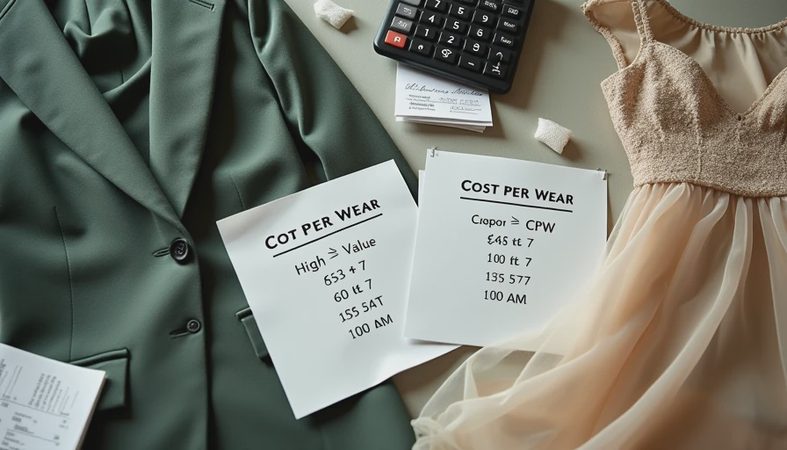
The math is uncomplicated: divide the purchase price by the number of times you expect to wear the item. A $90 jacket worn 30 times comes to $3 per wear. If you wear it 60 times, the number drops to $1.50. That doesn’t make every expensive purchase wise, but it gives you a more useful comparison than a sale sticker.
For example, imagine two everyday sweaters. Sweater A costs $28 and works with one pair of jeans, but the sleeves itch and the hem rides up when you sit. You wear it four times, so its cost per wear is $7. Sweater B costs $68, has a soft cotton blend, fits comfortably under a coat, and gets worn 25 times. That one comes to $2.72 per wear. The higher checkout price bought you more actual use.
The estimate needs to be honest. Don’t use an imaginary version of your life in which you attend six dinner parties a month if you mostly pick up takeout and help with homework. Count the occasions you really have: workdays, school events, grocery trips, church, travel, or weekends at the farmers market.
What cost per wear reveals about your closet
Cost per wear is especially helpful when two items serve the same job. Suppose you need black work pants. A $45 pair from a big-box store might look fine on the hanger, but the waistband rolls and the fabric bags at the knees. You wear them three times before relegating them to the laundry-day pile. That’s $15 per wear. A $95 pair with a secure waistband, useful pockets, and fabric that keeps its shape could be worn 35 times, bringing the cost to about $2.71.
This calculation also exposes the “almost right” category. I’ve watched women buy a blouse because the color was perfect, then spend the next month tugging at the neckline. The blouse isn’t a deal if it needs a camisole, special bra, constant steaming, and emotional negotiations before every wear. A garment that requires too much management has a high cost per wear, even if the receipt says $24.
Fit is part of the math. So is care. A washable dress that goes straight from the dryer to the hanger will probably get more use than a similar dress that requires dry cleaning. A blazer that works with jeans, trousers, and a knit skirt has more opportunities than one that only suits a single office outfit. Look at the whole outfit, not just the item in isolation.
A realistic example from a real closet
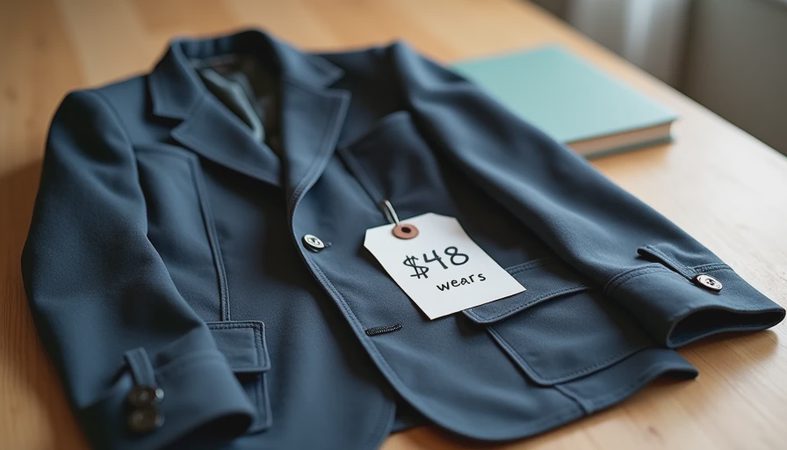
Let’s take a regular Midwestern wardrobe and run the numbers. A navy knit blazer costs $110. It works for a parent-teacher conference, a work presentation, dinner, and travel. If you wear it twice a month for a year, that’s 24 wears, or about $4.58 per wear. Add another 12 wears the following year and the figure drops to $3.06 overall.
Now compare a $60 embellished top purchased for one holiday gathering. It photographs nicely, but it feels too dressy for the office and too fussy for jeans. If it gets worn twice, the cost per wear is $30. There’s nothing wrong with owning a special-occasion piece. The problem is calling it a bargain because it was marked down from $90.
I’m not telling you to avoid clothes that bring you joy. Joy counts. So does comfort, confidence, and having something appropriate when the invitation arrives. I am asking you to name the purchase accurately. A two-wear party top is a special purchase, not a wardrobe workhorse.

How to use the math before you buy
Start by picturing three specific outfits you can make with the item. Not vague promises such as “I’ll wear it with everything.” Name the actual pieces: your straight-leg jeans, gray pants, denim skirt, or tan cardigan. If you can’t create three outfits from your current closet, the item has a steeper climb toward a reasonable cost per wear.
Next, test the practical details. Sit down. Raise your arms. Walk a few steps. Check whether the fabric pulls across the bust, whether pockets gape, and whether the hem works with the shoes you own. In a fitting room, I’d have women do this while looking in the side mirror. Clothes aren’t museum objects. They have to survive car rides, office chairs, grocery carts, and a child asking for a snack while you’re carrying six bags.
Then ask how often the item can realistically leave the house. A $150 wool coat worn 80 times over several winters can make excellent financial sense. A $150 white blouse that needs careful laundering and only works for formal meetings might not. The goal isn’t the lowest possible price. It’s the strongest match between price, comfort, and use.
When a higher price is worth it
Spend more when the garment solves a repeated problem. That might be jeans that stay comfortable after lunch, shoes that don’t hurt during a conference, or a coat warm enough for a January school-bus stop. Construction details matter: a lined jacket, sturdy buttons, reinforced seams, and fabric that holds its shape can add years of use.
Still, a higher price is not a guarantee. I’ve owned a $140 sweater that pilled after three wears and a $22 cotton shirt that became a weekly favorite. Read the fiber content, inspect the seams, and think about your habits. If you hate hand-washing, don’t buy a hand-wash-only piece and hope your personality changes.
Watch for the false economy of replacing basics repeatedly. Four $25 sweaters that lose their shape may cost $100 and create four mornings of irritation. One $75 sweater that you wash carefully and wear for years can be the calmer purchase. That is the kind of cost per wear math I want in a closet: practical, visible, and connected to real mornings.
A quick closet audit you can do this weekend
Choose five garments you wore often last month and five you ignored. Write down the original prices if you remember them, then estimate the number of wears. You’ll probably find that your favorites share qualities: comfortable fabric, easy colors, reliable fit, and compatibility with the rest of your wardrobe. Those clues are more useful than a trend report.
For the unworn items, be specific about the obstacle. Is the waistband wrong? Is the fabric scratchy? Does the top require a different bra? Does the dress have nowhere to go? If a small alteration could fix it, price that work before buying something new. A $15 hem can rescue a $70 pair of pants. If the problem is fundamental, let the garment go and stop treating the original price as a debt you must repay with guilt.
The best wardrobe isn’t the one with the most impressive receipts. It’s the one that supports your actual Tuesday, including the rushed coffee, the cold parking lot, and the meeting you forgot was today. Use cost per wear as a tool, not a rule. Buy fewer things you can name, reach for, and live in. Dressed for your real life.
No comments yet — be the first to share a thought.