I've spent years helping women in the fitting rooms at Von Maur, and the phrase retro style women's clothing gets thrown around a lot. Most advice on the subject is aimed at someone half my age with nowhere to be by 8 a.m. Let's reset. The goal isn't a costume. It's a wardrobe that looks like you, only with better sleeves and a waist that doesn't fight you all day.
What retro means around here
Retro doesn't have to mean full-on 1957. When I talk about retro style women's clothing, I mean pieces borrowed from the 1940s through the early 1970s that still work on a Tuesday. Think A-line skirts, capri pants, cardigans with real buttons, shirtdresses, high-waisted trousers, pointed flats. These cuts are more defined at the waist and more forgiving in the leg. That's geometry, not nostalgia.
What makes a piece read retro instead of just old is proportion, fabric, and details. A cotton shirtdress with a collar and a full skirt says 1950s, but it works with a denim jacket and sneakers. High-waisted wide-leg trousers in a drapey fabric say 1970s without demanding bell-bottoms. Change the shoes and the bag, and the whole thing disappears into a normal modern outfit.
Where retro style women's clothing actually hides
You don't need a time machine or a vintage dealer in New York. A good thrift store and a rough idea of what you want will do. I once found a 1960s leather belt at a Des Moines Goodwill for three dollars. A client scored a 1970s Pendleton skirt for twelve at a church rummage sale. Shop by fabric and shape, not label. Wool, cotton, and linen from that era hold up because it was made before fast fashion got cheap.

Etsy makes the online vintage game easier. Filter by size, era, and price, and most sellers list exact measurements instead of S/M/L. That matters because vintage sizes run small. A 1950s dress marked a size 14 might fit like a modern 8. If you don't want to gamble, look for sellers with clear measurements and a return policy.
Estate sales are where the good stuff hides — cashmere sweaters, full skirts, dresses with buttons intact. Prices are marked in pencil and negotiable if you ask late in the day.
How to wear it without looking like a time traveler
The fastest way to make retro style women's clothing work is to put it next to something completely normal. High-waisted 1970s trousers look modern with a white t-shirt and flat sandals. A 1950s shirtdress loses the costume factor when you layer a denim jacket over it and swap the pumps for sneakers. A 1960s twin set reads current with dark jeans.
The biggest mistake I see in dressing rooms is going all-in. Head-to-toe vintage — hat, gloves, dress, the works — reads as a themed party, not a wardrobe. That's fine if you're actually going to a themed party. Most of us are not.
Build the outfit the way you would anything else. One retro piece makes the anchor. Then add your regular jeans, your regular shoes, your regular jacket. The retro piece should be the most interesting part, not the entire costume.
The cost-per-wear math that settles everything
Here's the money talk. I once had a client who fell for a 1960s wool coat at a consignment shop. One hundred twenty dollars felt like a lot for someone who mostly drove carpool. Then we did the math:
Twenty wears a winter for five winters is one hundred wears. One hundred twenty dollars divided by one hundred is a dollar twenty per wear. A trendy blouse she buys for forty-five dollars and wears twice costs twenty-two fifty per wear. The blouse is the expensive one.
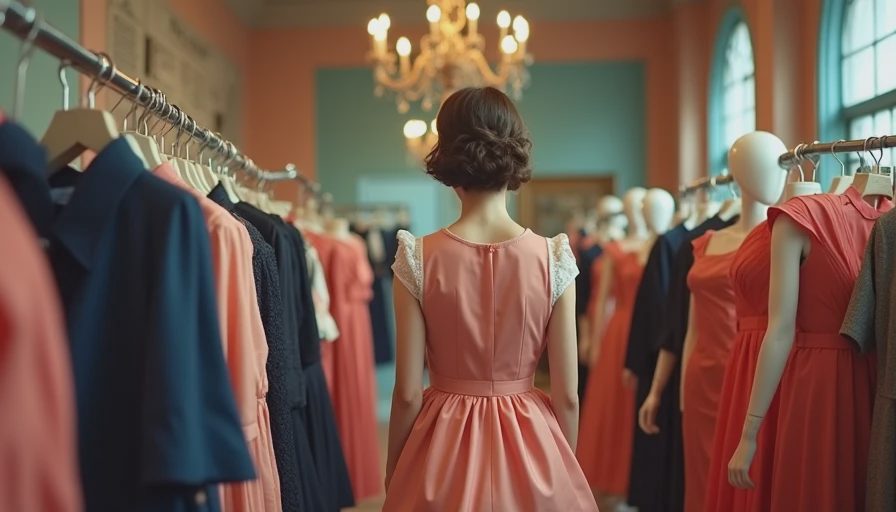
That's why I keep coming back to retro style women's clothing. They cost less upfront, and because they're not trend-driven, you'll still want them in five years. Before you buy anything, ask how many times you'll actually wear it. If it's under ten, it's too expensive at any price.
Where to spend and where to save
You don't need a big budget for a retro-inspired capsule. Start with a cardigan, a high-waisted trouser, and one dress that makes you feel like yourself. All three can be found at a thrift store for under thirty dollars if you dig. If you want new, Old Navy and Target make mid-century-inspired pieces cut for modern bodies, between twenty and fifty dollars. Look for the shape, not the label.
Spend more on pieces that need to fit well. Trousers with a substantial seam, a wool-blend skirt, a jacket that buttons easily — those are worth forty to seventy dollars because you'll wear them constantly. Save on accessories. A retro-style belt, a scarf, or vintage earrings from a flea market cost under ten dollars and do more heavy lifting than you'd think.
A few rules from my dressing room notebook
I keep a spiral notebook in my purse and jot down what women say in front of the three-way mirror. The most repeated line is, "I'm not sure this is me." That usually means the piece is wrong for their life, not their body. Retro style women's clothing is no different. If a vintage dress makes you tug at the zipper all day, pass.
The rules I bring home are simple. Buy for your actual week, not your imaginary one. Skip anything that needs constant adjusting. Trust the mirror when it tells you something feels easy. Clothes from fifty years ago were made to be worn, not displayed.
That's what I mean when I say dressed for your real life. Start with one great retro piece, wear it with your regular shoes, and let the rest of the outfit stay in the present. You'll spend less and feel more like yourself.



No comments yet — be the first to share a thought.