A cost per wear calculator sounds like something invented by a spreadsheet enthusiast who has never had to dress for a freezing school drop-off and a warm office on the same day. I understand the suspicion. But when you use it as a practical question rather than a permission slip to buy expensive clothes, it can tell you a lot about your closet. The basic question is simple: how much did each wearing really cost?
The formula is purchase price divided by the number of times you wear the item. A $120 pair of washable trousers worn 30 times costs $4 per wear. A $35 top worn twice costs $17.50 per wear. The cheaper price tag didn’t necessarily save you money. That’s the part we tend to miss while standing under bright fitting-room lights.
Start with the math, not the fantasy
A cost per wear calculator works best when you use realistic numbers. Don’t enter “I’ll wear this blazer every week” because the sales associate says it’s versatile. Ask whether you already have two blazers that do the same job, whether the fabric wrinkles in the car, and whether you’ll actually reach for it on a Tuesday morning.
Suppose you’re considering a $90 cardigan. You think you’ll wear it 20 times, so the projected cost is $4.50 per wear. That’s reasonable if it works with your jeans, black pants, skirt, and casual dress. If the sleeves are fussy and the color only works with one pair of shoes, you might wear it six times. Now the real cost is $15 per wear. The calculator didn’t make the decision; it exposed the assumptions.
I use the same exercise for shoes, especially. A $70 pair of loafers that pinches after ten minutes is not a bargain at any price. A $110 pair that handles walking, office floors, and grocery runs can become a $2 or $3 per-wear item over a couple of years. Comfort is part of the calculation because uncomfortable clothes stay in the closet.

What should count as a wear?
This is where people get unnecessarily complicated. One wear means you wore the item for an actual portion of your day, not that you tried it on in front of the mirror. Wearing a dress to a wedding counts. Wearing it for 15 minutes before changing into jeans does not.
For washable everyday clothes, count each separate outing or workday. If you wear the same sweater on Monday and again on Friday, that’s two wears, even if it never made it into the laundry basket between them. For a special-occasion dress, count the events you genuinely expect: perhaps one wedding, one holiday dinner, and one family photo session over three years.
Repairs and care belong in the total price. Add $12 for hemming, $8 for a zipper repair, or the cost of professional cleaning when those expenses are necessary to keep the garment in use. A $60 skirt with $20 in alterations has a $80 starting cost. That doesn’t make it bad; it gives you honest math.
I also count a failed purchase at its full price. If a $45 blouse gets worn once because it pulls across the buttons, its cost per wear is $45. Donating it afterward doesn’t turn the mistake into a savings win. It simply gives you useful information for the next fitting room visit.
Compare the whole outfit, not one item
A cost per wear calculator can make a single garment look like a winner while ignoring everything required to wear it. A $25 statement top may need a special bra, a camisole, delicate washing, and shoes you dislike. A $75 knit top might work with three jackets, regular undergarments, and the sneakers you already wear.
Try calculating the outfit cost. Imagine a $95 midi skirt, $20 camisole, and $65 sandals for a total of $180. If you wear the complete combination eight times, the outfit costs $22.50 per wear. That’s not automatically unreasonable for vacation dinners or summer events, but it’s not an everyday bargain either.
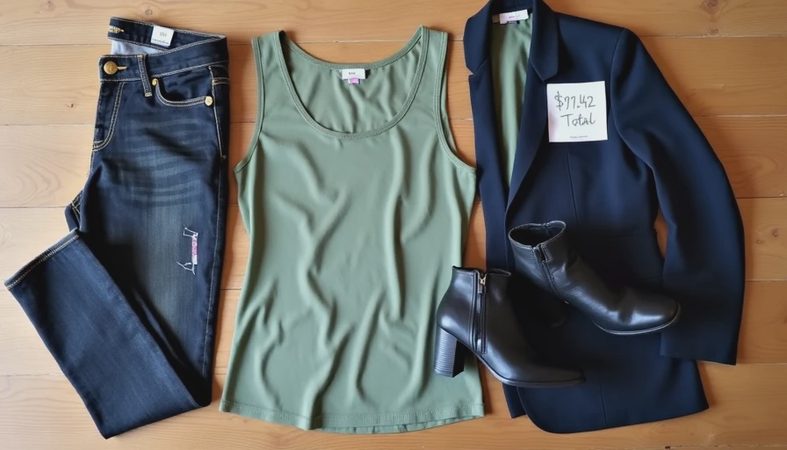
Now compare a $55 pair of dark jeans, a $35 cotton shirt, and your existing $40 belt. If you wear that combination 25 times, the total $130 costs $5.20 per wear. The second outfit is doing more work, even though none of its pieces looked especially exciting on the hanger.
This is why I ask clients to name at least three places they’ll wear something before buying it. “Work” is too vague. Say Monday staff meeting, Saturday library trip, and dinner at the neighborhood Mexican restaurant. Real occasions create better predictions than imaginary lifestyles.
Use the calculator before and after buying
Before buying, use a cost per wear calculator with a conservative estimate. Cut your optimistic wear count in half. If you believe you’ll wear the coat 40 times, run the numbers at 20. If the price still feels sensible, you’re looking at a stronger purchase. If it only works at 40 wears, pause and examine why.
After buying, keep a small note in your phone. Write “navy cardigan” and add a date each time you wear it. This takes seconds. After three months, you’ll know whether your prediction matched your life. I’ve had clients discover that their “special” blouses were worn constantly while their polished work pants sat untouched because the waistband was uncomfortable after lunch.
The result isn’t a grade. It’s a pattern. You may learn that you wear soft layers more than structured jackets, washable fabrics more than dry-clean-only pieces, or navy more than black. Your future shopping list should reflect that evidence.

When a higher price is worth it
Low cost per wear doesn’t require buying luxury labels. It requires fit, function, and repeatability. A $140 winter coat can be sensible in Iowa if it keeps you warm for several seasons and replaces two coats that never quite worked. A $18 tank can be expensive if the straps slide, the fabric pills, and it gets worn once beneath a cardigan.
Spend more when the item handles a job you do often: walking shoes, a winter coat, jeans that stay comfortable through a full day, or a work bag that carries your actual laptop. Save on items with short lives or low importance, such as a novelty color you’re testing or a holiday accessory.
Do not let the phrase “investment piece” bully you into keeping a garment you hate. An expensive item needs to be worn, not admired on a hanger. If the shoulders feel wrong in the fitting room, they won’t improve because the receipt says $180.
A practical five-minute shopping check
Before checkout, ask what the item replaces, what three outfits it joins, and how often you expect to wear it in the next six months. Estimate the purchase price plus alterations. Then divide by a wear count that feels slightly pessimistic. Finally, check the care label and imagine doing laundry on your busiest week.
For example, a $48 machine-washable sweater worn 12 times during the first season costs $4 per wear. If it remains comfortable and intact, the number drops below $2 after another season. That is useful information, not a demand that every shirt become a mathematical triumph.
The best cost per wear calculator is the one that helps you notice your real habits. Buy for the life you have, not the imaginary version with daily brunches and no muddy shoes in the back seat. A closet full of dependable clothes is not boring. It’s peaceful. Dressed for your real life.

No comments yet — be the first to share a thought.